The climate is mild all year round, due to the North Atlantic Drift. The country suffers neither extremes of heat and cold. Weather can be somewhat unpredictable, but rarely challenging! The west has a higher rainfall than the east, due to its proximity to the Atlantic and the prevailing southeasterly wind. The rainfall and the rich soils, particularly of the midlands, account for the country's green appearance.
Guided Rambler Tours
The Wicklow Mountains ...
"heather, sheep trails and hidden lakes"
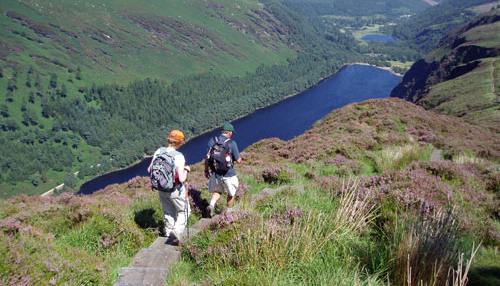
This wonderful range of heather-clad hills and glaciated valleys is situated just south of Dublin City. Its spectacular waterfalls, abundance of wildlife (including red and Sidka deer on the hills), sleepy villages and plenty of traditional pubs make it the ideal place for a week's walking.
The history of the county is tainted by bloody battles and rebel legends. Glenmalure for instance was the site of a major battle between Irish rebel forces and a small English army. In this case the English were savagely beaten, but soon after a chain of military barracks appeared across the hills at Glencree, Laragh, Glenmalure and Aughavanagh, the ruins of which can still be seen. Today it's a much friendlier place of course, and one of the attractions is the many large private estates dotted throughout the county. The estate owners protect the natural environment and hold on to valuable traditions in land management. Many of the large oak woods were planted for timber production and hunting. The Sidka deer roaming the mountains and forests today were imported into Powerscourt Estate by Lord Leicester, red grouse still thrive on the heather covered hills, and the many lakes are unpolluted and full of brown trout. Even otters and badgers are still seen quite regularly.
You are based near Glendalough for the week, an ideal location for exploring these valleys and woodlands. You visit the Glenmalure valley, Luggala private estate and the 10th century monastic city at Glendalough. This wonderful tour includes easy walks and interesting visits. In the evenings you can visit several traditional pubs where music is laid on and enjoy a creamy pint of Guinness or Irish coffee. Wicklow's proximity to Dublin means you can easily extend your holiday with a few nights in Dublin.
2000 DATES
June 10-17 (sat) July 8-15 (sat) Aug 26-Sept 2 (sat) Sept 30-Oct 7 (sat)
(Meeting Point: Dublin Airport at 11:00 am or between 12.00 and 15.00 hours at Coolakay House - ask for details)
PRICE: $745 (single room + $115) DEGREE OF DIFFICULTY ***
Not included: Entries to visitors centers
see: day to itinerary
The Burren, Connemara, and Aran Islands
"rare flowers, historic islands and mountain wilderness"
The great variety in scenery of counties Galway and Clare have made this one of our most popular tours, and the ideal introduction to hiking in Ireland. The walking terrain varies from open mountain to minor country lanes, from hiking trails to sandy beaches.
Connemara has some of the most impressive mountain landscapes in Europe, with rugged granite outcrops and glaciated valleys. Its seemingly desolate bog landscape, when experienced on foot, reveals a rich natural history. The landscape can be awash with colour when autumn arrives, and rare wildlife around Roundstone Bog includes the otter and merlin. There are even several rare insect-eating plants to be found. Evidence of past settlements testifies to a fascinating human history too, from ancient seafaring nations to the warring medieval clans. Hikes include Killary Harbour, Ireland’s only fjord, and Errisbeg Mountain near the fishing village of Roundstone. We spend four nights in the Inagh Valley in between the Twelve Bens and Maumturk mountains, staying in a comfortable family run guesthouse.
Inishbofin has a population of only about 200 and is a typical island off the west coast of Ireland. A boat trip and short walk on the island make for a special experience and unforgettable day trip.
The rich limestone country that makes up the Burren in northwest Clare appears harsh and barren, but there are thousands of sites to visit and a variety of flora unrivalled in northern Europe. Be prepared for a unique experience as you discover megalithic tombs, early Christian churches, Holy Wells and many more places of archaeological interest. The spring and summer months, and the mild Atlantic climate bring forth a huge variety of rare arctic and mediterranean plants, including wild orchids and gentians. Our last three nights are spent in Kincora House a comfortable guesthouse with its own restaurant and bar in lively Lisdoonvarna, home of the world famous matchmaking festival and traditional music sessions.
2000 DATES
May 21-28 (sun) June 17-24 (sat) June 25-July 2 (sun) July 15-22 (sat) Aug 20-27 (sun) Sept 9-16 (sat) Sept 17-24 (sun) Sept 30-Oct 7 (sat)
(Meeting Point: Shannon Airport 11:00 am or between 14.00 and 16.00 hours at Imperial Hotel, Lisdoonvama - ask for details)
PRICE: $775 (single room + $115) DEGREE OF DIFFICULTY * /**
Not included: Ferry tickets, entries to visitors centers
see: day to itinerary
Highlands of Kerry...
"remote mountains, spectacular coastline and ancient monuments"
Kerry's lush woodlands, pristine lakes, majestic mountains and colourful villages make it Ireland's premier hiking county. The warming waters of the Gulf Stream and its mild climate have given Kerry a curious abundance of palm trees, wild rhododendron forest and fuchsia hedges. The county, known locally as The Kingdom, has been attracting visitors since the time of Queen Victoria's Royal visit in the mid-19th century, but the early Milesian settlers were here a long time before that. They and their descendants farmed, fished and mined until the coming of the first Celtic tribes around 500 BC. Kerry's native population merged with all newcomers until the Anglo-Norman invasions when most of the county ended up in the hands of English landlords or army officers. Over the years many of the locals have had to emigrate, but now most make a living from farming, service industry or tourism.
Your tour includes wonderful hikes across mountain passes, old country lanes and mountain trails and also visits to some of the colourful villages and towns, including Waterville, Sneem, Killarney and Caherdaniel. The Iveragh Peninsula has countless historical and archaeological sites to discover, and some of these are on the itinerary. During the week you will also have the chance to buy some local crafts, enjoy a chat with the locals, and make visits to lively pubs, where you might hear a traditional music session. Your base is in Glenbeigh village on the famous Ring of Kerry. After a day's hiking you can really appreciate the delightful spacious rooms with private bathroom, and the wholesome evening meals served in your guesthouse (or sometimes in a nearby hotel). Glenbeigh is a busy place with many visitors passing through and several pubs, so you have the opportunity to enjoy free time away from your group if you wish. The village is very close to the Atlantic Ocean, so you can even take a walk down to the sandy beach at Rossbeigh.
2000 DATES
May 14 - 21 (sun) June 10-17 (sat) June 18-25 (sun) July 8-15 (sat) Aug 13-20 (sun) Aug 26-Sept 2 (sat) Sept 3-10 (sun) Oct 7-14 (sat)
Meeting Point: Shannon Airport 11.00 am or between 12:00 and 16:00 in Glenbeigh
PRICE: $755 (single room + $115) DEGREE OF DIFFICULTY **
Not included: Ferry tickets, entries to visitors centers
see: day to itinerary
The Dingle Peninsula ...
"remote mountains, spectacular coastline and ancient monuments'
The Dingle Peninsula is a paradise for the walker. Old roads and pathways free of traffic reach into the heart of a landscape dominated by mountains and hills, sea and cliffs. Many of these routes are bordered by lush hedgerows in which the red-flowered fuchsia predominates, and the hikes often pass close by the historical and archaeological sites - many dating back to the pre-Celtic and Early Christian era - for which the peninsula is renowned. You simply cannot see them all in a week but we try to show you some of the more better known and impressive ones, including Gallarus Oratory and the beehive huts at Slea Head, dating back to the 6th century. Of course we visit the small fishing port of Dingle, where you can visit some interesting craft shops and music pubs, and maybe spot the resident dolphin in the bay. Our walking programme of carefully planned routes is an introduction to the most picturesque scenery, sights and attractions of the Dingle Peninsula. We also take a boat trip to visit the atmospheric, uninhabited Blasket Islands, the western-most extremity of Europe.
The tour is based in Annascaul, a delightful small village in the middle of the peninsula within good driving distance of Dingle town and Tralee. A comfortable guesthouse and a real Kerry welcome await you here, as well as wonderful food, with a change in menu each day. You will also have a chance to pay regular visits to Dan Foley's pub, and perhaps arrange an evening visit to the traditional Irish folk theatre in Tralee. Groups are from 6 to 15 people, with various nationalities including North American, Dutch, German, Belgian, French, British and Irish.
2000 DATES
May 14 - 21 (sun) June 10-17 (sat) June 18-25 (sun) July 8-15 (sat) Aug 13-20 (sun) Aug 26-Sept 2 (sat) Sept 3-10 (sun) Oct 7-14 (sat)
(Meeting Point: Shannon Airport at 11:00 am or between 12.00 and 16.00 hours in Anascaul - ask for details)
PRICE: $775 (single room + $115) DEGREE OF DIFFICULTY **
Not included: Ferry tickets, entries to visitors centers
see: day to itinerary
West Cork Hiking Tour
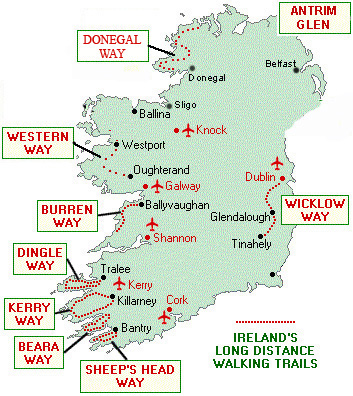
West Cork is Ireland's equivalent to the French Riviera. Its spectacular coastline, lively seaside resorts, excellent seafood and rural tranquility has made this a favourite holiday destination, and yet it is still one of Ireland's most sparsely populated areas. The Beara Peninsula has a fascinating mixture of small resorts like the fishing port of Castletownbere, the thriving town of Kenmare, and colourful villages such as Eyeries and Allihies. These places enjoy a busy tourist trade, but still give an experience of traditional Irish life and a warm welcome.
The walks on this tour cover the entire peninsula and a wide range of scenery, mostly near the coastline. There is some easy walking on forest paths around Glengarriff Nature Reserve and there is some harder walking along some of the Beara Way trail. West Cork has numerous archaeological remains and sites (including stone circles and prehistoric ringforts), some of them hidden amongst rocks or vegetation, but others standing proudly on top of hills or overlooking the ocean. Most of these sites go back to the early to late Bronze Age (2000-1000BC) and many belong to the Iron Age (500BC). Apart from the archaeological treasures there are also the remains of the copper mining industry at Eyeries. Midweek we take a short boat trip to Bere Island, which is rich in military history. Perhaps the climax of the week is a trip by cable car to Dursey Island, where there are stunning views of the Atlantic.
Your base will be in Glengarriff, a bustling traditional village, in a small family run hotel. Here you can expect attention to detail and a genuine personal touch. Each evening a wholesome three course meal is served, and lunches are made up for you by the hotel's staff each morning. All being well there should be the occasional traditional music session in the area. Groups are from 6 to 15 people, with various nationalities including North American, Dutch, German, Belgian, French, British and Irish.
2000 DATES
June 10-17 (sat) July 8-15 (sat) Aug 26-Sept 2 (sat) Oct 7-14 (sat)
(Meeting Point: Cork Airport at 11:00 or between 14.00 and 16.00 hours at the Casey's Hotel)
PRICE: $745 (single room + $115) DEGREE OF DIFFICULTY **
Not included: Entries to visitors centers
see: day to itinerary
Mayo/Sligo/Donegal Hiking Tour
Many of our previous clients have asked for a longer walking tour and walks in new areas, so this tour has been designed accordingly. The north west of Ireland is still regarded by many visitors as the “real”, unspoilt Ireland. This sparsely populated and mountainous region has not been developed like other areas. The magnificent scenery of places such as Achill Island, the cliffs at Slieve League in Donegal and Glenveagh National Park are already well-known, but this particular walking tour also includes some lesser known places such as the Yeats country of Sligo and peaceful county Roscommon.
Some places not featured before in any of our tours are: Louisburgh in county Mayo where you can enjoy a new coastal walk; Clare island off the coast of Mayo; a pilgrim's walk in the shadow of Croagh Patrick, and Lough Derg in Donegal where thousands of Irish people join an annual religious retreat.
Accommodation is in comfortable guesthouses and some small hotels along the way. A minibus will be on stand-by most days allowing you to perhaps take a break or do some shopping in between. Of course your guide will be on the look-out for that special traditional music session or local cultural festival, of which there are many. Having the luxury of a two week tour also means that all the group members can get to know each other even better!
2000 DATES - 15 days/ 14 nights
June 10; August 19; September 2
(Meeting Point: Sligo or Knock Airport between 12.00 and 16.00 hours)
PRICE: $1,475 (single room + $245) DEGREE OF DIFFICULTY **
Not included: Entries to visitors centers
see: day to itinerary
EQUIPMENT YOU NEED TO BRING: ...
There are other airports in Ireland, including Sligo and Galway, which operate a service to the Aran Islands. We will make sure that you arrive at the best location, whether by land, sea or air.
CLIMATE
Ireland's mild and humid climate is ideal for walking. You will never feel too hot! The summers are pleasantly warm. However, we do get rain and you need to bring a good weatherproof coat and trousers, sturdy day rucksack and most important of all, sturdy waterproof boots are vital to the success of your holiday. Temperatures reach a maximum of 25C/80F in summer with variations down to 15C/60F on some days.
Ireland at a glance...
(or scroll down to read detailed information on each topic covered):
Location:
Ireland is the westernmost island in Europe, located west of the United Kingdom. It's actual location is 51.5 degrees and 55.5 degrees north latitude and 5.5 degrees and 10.5 degrees west longitude.
Size:
Width: 170 miles (275 kilometres) at its widest point.
Length: 301 (486 kilometres) at its longest point.
Area: Total 84,421 square kilometres (32,595 square miles).
Republic of Ireland: 70,282 square kilometres (27,136 square miles)
Northern Ireland: 14,139 square kilometres (5,459 square miles).
Total coastline:
3,172 kilometres of coastline (1,970 miles)
Population:
The Republic of Ireland's population is estimated at 3,621,000 (1996). Of this, over 1 million live in the greater Dublin area.
Climate:
Temperate zone; mild all year round, due to the North Atlantic Drift.
Coldest months: January and February with average temperatures of 4 to 7 degrees Celsius during the day.
Warmest months: July and August with average temperatures of 14 to 16 degrees Celsius. The sunniest months are May and June, with between five to seven hours of sunshine per day.
Average annual rainfall: 750 mm (30 inches) in some Eastern areas
800-1200 mm (31 to 47 inches) in low lying areas
1500 mm (59) inches in parts of the west
2000 mm (79 inches) or more in mountainous areas
Political Boundaries:
Ireland consists of four provinces, broken up into 32 counties as follows:
Ulster (in the north): Cavan, Donegal, Monaghan (in the Republic), Antrim, Armagh, Derry, Down, Fermanagh and Tyrone (in Northern Ireland).
Leinster (in the east): Carlow, Dublin, Kildare, Kilkenny, Laois, Longford, Louth, Meath, Offaly, Westmeath, Wexford and Wicklow.
Munster (in the south): Clare, Cork, Kerry, Limerick, Tipperary and Waterford.
Connaught (in the west): Sligo, Mayo, Galway, Roscommon and Leitrim.
Time zone information:
In late October to March, Ireland is on GMT (5 hours ahead of US Eastern time). In late March to October Ireland, is on GMT + 1 (6 hours ahead of US Eastern Time) Ireland goes to daylight saving time 2 weeks ahead of the U.S.