|
Horseback riding tours
Rides in
Kenya
Intro to Kenya
----------------------------
![]() Tanzania Tanzania![]() Uganda Uganda
|

|
|

|
|
|
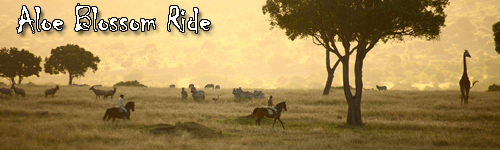
Masai Mara Ride - Aloe Blossom
Masai Mara
Kenya
A nine-day exploration safari on horseback in the Masai Mara wilderness area.
The Masai Mara Game Reserve and Greater Mara Conservancies represent most people’s idea of East Africa. The landscape is one of rolling savanna, intersected by dark green veins of riverine woodland on the banks of the Mara and Talek rivers. This wilderness is an extension of the Serengeti (Tanzania) ecosystem and is considered by many to be Kenya's best wildlife sanctuary, where animals can still be seen in vast numbers. Lion, leopard, cheetah, elephant, hippo, crocodile, antelope and gazelle are some of the many species to be found. The annual migration of up to one million wildebeest is most dramatic and considered to be one of the greatest wildlife spectacles in the world. Needless to say, both wildlife and bird viewing are phenomenal. The Mara is also home to the colorful and handsome Masai people who, with their herds of livestock, are synonymous with the region.
The Masai Mara Game Reserve & Greater Mara Conservancies
Altitude 5,000-6,000 ft. ~ Area 5,000 sq. km ~ Gazetted in 1961.
|
Camping Ride with vehicle support
Family Vacation
Safari Ride
|
|
Meeting:
|
Hotel in Nairobi
|
|
Airport:
|
Jomo Kenyatta International Airport (NBO)
|
|
Transfer:
|
Kenya International Airport/ hotel
|
|
Riders:
|
Min
4 riders
Max
12 riders
(per riding group)
Max Capacity
12
|
|
Trip Brochure (PDF)  Trip Rating

|
|
|
|
Rates include*:
Accommodations, All meals, All drinks in camp including bottled drinking water , 7 or 9 riding days (depending on program) with a Kenya Professional Safari Guide, Safari crew (cooks, waiters, mechanics, drivers, grooms, porters and tent stewards), 4x4 game viewing vehicles, Day & night game drives, Laundry in camp, Flying Doctors Membership, Airport Transfers, Return flight Nairobi-Mara & Gov't taxes
| A | 2026 | 9 day trip | 9d / 8n | $12450 |
| Wilderness Conservancy Fee (MANDATORY) | $1750 |
| Small group supplement (4 guests or less), pp | $13750 |
| Single room supplement (requested) | $2750 |
| B | 2026 | 7 day trip | 7d / 6n | $9950 |
| Wilderness Conservancy Fee (MANDATORY) | $1350 |
| Small group supplement (4 guests or less), pp | $10500 |
| Single room supplement (requested) | $2250 |
* prices are per person based on double/twin occupancy
Transfer and Other Charges:
|
2026
|
Return flight from Nairobi - Mara - Nairobi included.
|
|
2026
|
Transfer included from Jomo Kenyatta International Airport to hotel on Day 0, return.
|
Transfers are included for this trip.
Since rarely any flights arrive in time for the transfer on Day 1, please arrive the night before. Our partners can pick you up from the Jomo Kenyatta International Airport (NBO) once your flight lands and drop you off at your hotel (night at the hotel not included in the package).
On Day 1, you will be picked up from your hotel in Nairobi around 9:00am and transferred to Wilson Airport. The flight departs at 10:30am and lands in the Mara for 11:15am.
On the last day, your flight departs at 2:45pm and lands at the Wilson Airport for 4:15pm. You will then be transferred to Jomo Kenyatta International Airport.
Additional dates are available on request (except for April, May and November) - Book early - space is very limited in the Mara.
Enquire for private departure or as an extension to a beach stay or a visit to the gorillas, etc.
|
Rates do not include:
Gratuities, Insurance (mandatory), Wilderness Conservancy Fee (mandatory), Accommodation and meals outside of safari itinerary (Day 0) & Champagne, premium spirits, and cellar wines.
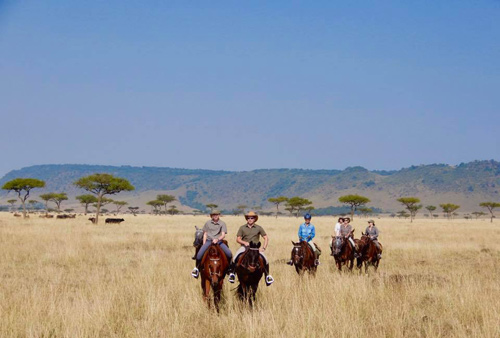 Sample Itinerary: 9-day program - subject to changes
Day 0: Pre-trip night
Sample Itinerary: 9-day program - subject to changes
Day 0: Pre-trip night
On arrival in Nairobi we will meet you at Jomo Kenyatta International Airport and transfer you to your hotel (meals and overnight not included).
Day 1: Flight to Mara
You will be met and transferred from your hotel to Wilson airport for a safari briefing. Our morning flights departs at 10:30am and arrives in the Mara at approximately 11:15am. Your professional safari riding guide will meet you there for a game drive to our private-canvas mobile camp arriving in time for lunch. The afternoon is spent settling in, followed by a short ride or game drive.
Riding distance: 5-10km
Meals: Lunch and dinner
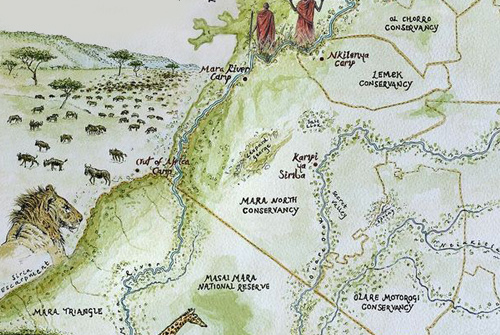
Accommodations: Nkilenya, Lemek Conservancy
Day 2: Lemek Ride
Morning and afternoon exploring the riverine forests and open plains of Lemek. There is an abundance of wildlife here including giraffe, warthog, zebra, hartebeest, topi, wildebeest, and with a little luck, cheetah and leopard too. Bloody Marys in the morning and Pink Gin for 'sundowners' in the evening. All-in-all, a heavenly first day on safari.
Riding distance: 10-15km
Meals: All meals in camp
Accommodations: Nkilenya, Lemek Conservancy
Day 3: Mara River Ride
Our first full day in the saddle takes us through spectacular wildlife country with impala, gazelle, elephant, buffalo, ostrich, and more! Picnic lunch is enjoyed in a patch of forest called Olomai. After a siesta, we ride to banks of the Mara River with its' large pods of hippo and the odd monster crocodile.
Riding distance: 20-25km
Meals: Breakfast and dinner in camp, picnic lunch
Accommodations: Mara River, North Conservancy
Day 4: Siria Escarpment Ride
A stunning area to traverse by horse or vehicle. We may ford the Mara River and ride under the iconic Siria Escarpment. The concentration of game is breathtaking and with plenty of opportunity to jump fallen trees created by the resident elephant. Waterbuck, eland, jackal, hyena, and lion occur, as do many other wildlife species.
Riding distance: 10-15km
Meals: All meals in camp
Accommodations: Mara River, North Conservancy
Day 5: Mara Triangle Ride
After a 'full-monty' breakfast we ride in a southerly direction across the Maternity Plain. Stunning views in every direction and excellent going for the horses. We cross the Mara River on horseback and enter the famous Mara Triangle. Picnic lunch is enjoyed in a patch of thick forest often occupied by elephant. After lunch, a short ride, followed by an ascent on foot, to the top of the escarpment.
Riding distance: 20-25km
Meals: Breakfast and dinner in camp, picnic lunch
Accommodations: Out Of Africa Camp, Mara Triangle
Day 6: Game Ride in Mara Triangle
Options to ride and drive in the triangle with magical views looking down towards the Serengeti in the distance. This corner of the ecosystem is blessed with croton thickets, forest, and endless tall grasslands, the perfect environment for rhino, elephant, buffalo, and lion. In the late afternoon we may visit a small traditional homestead of our local Masai hosts.
Riding distance: 10-15km
Meals: All meals in camp
Accommodations: Out Of Africa Camp, Mara Triangle
Day 7: Koiyaki Plain Ride
Today we descend the escarpment on foot and head due east, riding back over the Mara River, skirting the large village of Rianta and onwards, to a lovely picnic lunch under scattered acacia trees. After a long siesta we ride over the Koiyaki Plain and to our new camp on the Olare Orok Stream, used by the Masai to water their cattle.
Riding distance: 20-25km
Meals: Breakfast and dinner in camp, picnic lunch
Accommodations: KO8, Mara North Conservancy
Day 8: Mara North Conservancy Ride
Morning and afternoon ride, drive or walk, in this magical corner of the Mara. Exceptional riding country, where two large prides of lion make this area their home, allowing for sensational big-cat experience. We may go out after supper by vehicle with a spotlight to discover nocturnal creatures.
Riding distance: 15-20km
Meals: All meals in camp
Accommodations: KO8, Mara North Conservancy
Day 9: Flight to Nairobi
Our last morning ride or drive following the banks of the river. Wonderful opportunities for long canters over the Serian and Maternity plains. After a hearty brunch we say our goodbyes to the horses and camp crew. Our afternoon flight to Nairobi departs at 2:45pm. Upon arrival at approximately 4:15pm, you will be transferred to JKIA for your international flight home.
Riding distance: 10-15km
Meals: Brunch in camp
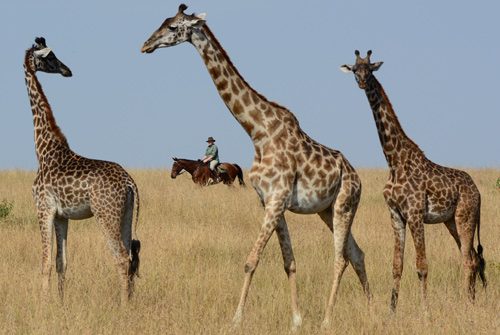 Sample Itinerary: 7-day program - subject to changes
Day 0: Pre-trip night
Sample Itinerary: 7-day program - subject to changes
Day 0: Pre-trip night
On arrival in Nairobi we will meet you at Jomo Kenyatta International Airport and transfer you to your hotel (meals and overnight not included).
Day 1: Flight to Mara
You will be met and transferred from your hotel to Wilson airport for a safari briefing. Our morning flights departs at 10:30am and arrives in the Mara at approximately 11:15am. Your professional safari riding guide will meet you there for a game drive to our private-canvas mobile camp arriving in time for lunch. The afternoon is spent settling in, followed by a short ride or game drive.
Riding distance: 5-10km
Meals: Lunch and dinner
Accommodations: Nkilenya, Lemek Conservancy
Day 2: Lemek Ride
Morning and afternoon exploring the riverine forests and open plains of Lemek. There is an abundance of wildlife here including giraffe, warthog, zebra, hartebeest, topi, wildebeest, and with a little luck, cheetah and leopard too. Bloody Marus in the morning and Pink Gin for 'sundowners' in the evening. All-in-all, a heavenly first day on safari.
Riding distance: 10-15km
Meals: All meals in camp
Accommodations: Nkilenya, Lemek Conservancy
Day 3: Mara River Ride
Our first full day in the saddle takes us through spectacular wildlife country with impala, gazelle, elephant, buffalo, ostrich, and more! Picnic lunch is enjoyed in a patch of forest called Olomai. After a siesta, we ride to banks of the Mara River with its' large pods of hippo and the odd monster crocodile.
Riding distance: 20-25km
Meals: Breakfast and dinner in camp, picnic lunch
Accommodations: Mara River, North Conservancy
Day 4: Siria Escarpment Ride
A stunning area to traverse by horse of vehicle. We may ford the Mara River and ride under the iconic Siria Escarpment. The concentration of game is breathtaking and with plenty of opportunity to jump fallen trees created by the resident elephant. Waterbuck, eland, jackal, hyena, and lion occur, as do many other wildlife species.
Riding distance: 10-15km
Meals: All meals in camp
Accommodations: Mara River, North Conservancy
Day 5: Maternity Plain Ride
After a 'full-monty' breakfast we ride in a southerly direction across the Maternity Plain. Stunning views in every direction and excellent going for the horses. Picnic lunch is enjoyed in a patch of thick forest often occupied by elephant. After a long siesta we ride past a game-rich saltlick and onwards to our new camp on the Olare Orok Stream, used by the Masai to water their cattle.
Riding distance: 20-25km
Meals: Breakfast and dinner in camp, picnic lunch
Accommodations: KO8, Mara North Conservancy
Day 6: Mara North Conservancy Ride
Morning and afternoon ride, drive or walk, in this magical corner of the Mara. Exceptional riding country, where two large prides of lion make this area their home, allowing for sensational big-cat experience. We may go out after supper by vehicle with a spotlight to discover nocturnal creatures.
Riding distance: 15-20km
Meals: All meals in camp
Accommodations: KO8, Mara North Conservancy
Day 7: Flight to Nairobi
Our last morning ride or drive following the banks of the river. Wonderful opportunities for long canters over the Serian and Maternity plains. After a hearty brunch we say our goodbyes to the horses and camp crew. Our afternoon flight to Nairobi departs at 2:45pm and lands at 4:15pm. You will be transferred to JKIA for your international flight home.
Riding distance: 10-15km
Meals: Brunch in camp
Non-Riders
Non-Riders are welcome! They will spend their days game viewing in our customized safari vehicle with their own professional safari guide.
Meeting:
Hotel in Nairobi
Airport:
Jomo Kenyatta International Airport (NBO)
Transfer:
Kenya International Airport/ hotel
Distance:
150 miles
Transfers are included for this trip.
Since rarely any flights arrive in time for the transfer on Day 1, please arrive the night before. Our partners can pick you up from the Jomo Kenyatta International Airport (NBO) once your flight lands and drop you off at your hotel (night at the hotel not included in the package).
On Day 1, you will be picked up from your hotel in Nairobi around 9:00am and transferred to Wilson Airport. The flight departs at 10:30am and lands in the Mara for 11:15am.
On the last day, your flight departs at 2:45pm and lands at the Wilson Airport for 4:15pm. You will then be transferred to Jomo Kenyatta International Airport.
|
Tack:
|
|
English tack - General all purpose English saddles, and French Calvalry saddles. Most horses go in a snaffle bit. Double sided saddle bags are provided.
|
|
Horses:
|
|
Somali-Arab crossbreds & Thoroughbreds.
|
|
Pace:
|
|
Moderate with long trots and canters, 4-8 hrs per day, covering 20-40km
|
Walk |
Trot |
Canter |
|
|
Level:
|
|
 (3
to
3
out of 5) Intermediate+
(3
to
3
out of 5) Intermediate+
|
|
Age:
|
|
Min
8
|
Max
80
|
|
Weight:
|
|
Max
200 lbs / 90 kg
|
|
Riders:
|
|
Min
4 riders
|
Max
12 riders
(per riding group)
|
Max Capacity
12
|
 Riding Level
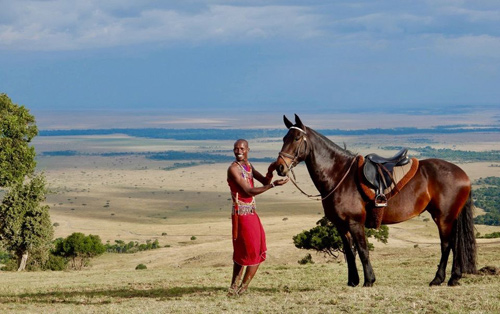
Participants should be competent and confident at all paces (surprises in the bush cannot be predicted) and have an intermediate level of fitness and riding ability. Riders must have the ability to trot for stretches of 10 minutes at a time and be able to gallop out of trouble.
The guide will assess the capability of each rider and should he feel that any rider is not competent and therefore imposes a risk to themselves or others, he will ask them to continue the safari in a vehicle rather than on horseback.
Pace
We ride between 4 to 8 hours, covering 20 to 50 kilometers per day. Full days of riding when we move camp are alternated with days where we ride out of camp and return for lunch and a siesta in the afternoon.
Horses
Our stable is home to over 25 safari horses – a mixture of Somali-Arab crossbred and thoroughbreds. The majority of these have been bred and raised at home on our wildlife conservancy in central Kenya. Living at close quarters with wild animals, our horses are familiar with being amongst big game, have great endurance and are evenly tempered. Under the professional guidance of our horse master and her team of grooms, each safari horse is carefully schooled, exercised, and loved, for the sole purpose of carrying our guests safely through the African wilderness.
Tack
We ride in the English style using very comfortable French cavalry and English general–purpose saddles. Most horses are tacked in a snaffle bridle and double-sided saddlebags are provided for each member to carry water bottles, cameras, and rain gear.
Safety
A professional riding guide leads every safari. A safety briefing is given at the beginning of the safari with detailed information about how to handle a big game situation.
A small medical kit is carried on horseback and a more comprehensive kit is kept in camps.
The mobile camps, vehicles, and guides have radio communication, mobile phones, or satellite phones in case of an emergency.
Insurance
It is one of our conditions that all guest must have adequate medical and comprehensive travel insurance in case of cancellation, curtailment and other emergencies, should they arise. Insurance details must be provided prior to travel.
Flying Doctor
We provide all our clients with membership to the Flying Doctors Society of Kenya. This service covers emergency medical evacuation to a hospital in Nairobi, at which point your personal medical insurance will take effect.
Weight Limit
Our weight limit is 90 kg (200 lbs). However, we can offer a special program for heavier riders, including shorter rides, game drives, walks and cultural visits.
Staff
Gordie was initiated into the safari world as a youngster. Born in Kenya, he guided his first safari aged 18 and has over 30 years’ experience in the bush. Today, his untamed love of all things wild and his passion and respect for Africa’s people and wildlife, make Gordie a fascinating and inspiring character.
Felicia’s talents encompass all aspects of safari – she’s a brilliant equestrian, an inventive chef, a qualified Bowen therapist and engaging company. She married Gordie in 2014.
Pete has been a professional safari guide for over 45 years. He has dedicated much of his life to conservation and is very proud to have been a founder member of the Masai Mara Conservancy and an honorary warden with the Kenya Wildlife Service.
Pierre is a third generation Kenyan who grew up living under canvas with his father, a well-known conservationist. He feels most at home in the bush. Pierre spends all of his time on safari with guests or friends. His love of the bush is contagious and his knowledge is outstanding.
Non-Riders
Non-riding participants are welcome to join their riding partners. They will spend their days game viewing in a safari vehicle (4x4) or on foot with their own professional safari guide.
Passport and Visa Requirements:
Passport valid for three months from date of entry required by all nationals referred to in the chart with at least one blank page.Required by all nationals referred to in the chart above except the f. more
Nairobi area
|
Month
|
Jan
|
Feb
|
Mar
|
Apr
|
May
|
Jun
|
Jul
|
Aug
|
Sep
|
Oct
|
Nov
|
Dec
|
|
Average High Temperature (°F)
|
78
|
81
|
80
|
77
|
74
|
73
|
72
|
72
|
77
|
78
|
75
|
76
|
|
Average Low Temperature (°F)
|
60
|
61
|
62
|
61
|
60
|
57
|
55
|
55
|
56
|
59
|
60
|
60
|
|
Average High Temperature (°C)
|
26
|
27
|
27
|
25
|
24
|
21
|
22
|
22
|
25
|
26
|
24
|
25
|
|
Average Low Temperature (°C)
|
16
|
16
|
16
|
16
|
15
|
14
|
13
|
13
|
13
|
15
|
16
|
16
|
|
Average Precipitation (days of rain)
|
5
|
3
|
7
|
12
|
10
|
3
|
1
|
1
|
2
|
5
|
13
|
8
|
Source: NOAA
Seasons
Seasonal rains govern Kenya's weather:
- Long rains (April to May)
- Dry season (December to March & June to November)
- Short rain (November)
However, we can expect the occasional rain showers throughout the year. Our rides are set at approximately 4,500ft- 7,500ft above sea level, which makes for idyllic riding weather. Temperatures usually range from 10 C- 30 C. It is often sunny during the mornings with cloud building-up in the afternoons – during the rains this develops into thunderstorms in the afternoon and evening. Temperatures usually range from 10 C- 30 C.
Peak season is between July and October, during the migration. Early November and February can also offer excellent game viewing.
Special note – Wildlife
The Mara is known as one of the finest wildlife destinations in the World. There is an excellent chance of seeing the Big 5, cheetah, serval, hyena, bat-eared foxes, black-backed and side-striped jackals, hippo, crocodile, baboons, warthog, topi, eland, Thompson’s gazelle, Grant’s gazelle, impala, waterbuck, oribi, reed-buck, zebra.
The Mara Naboisho Conservancy has a higher density of wildlife than the adjacent Masai Mara National park.
The conservancy has the big cats in big numbers. In fact, with roughly 100 lions living in the vicinity, it has one of the highest lion densities in the world.
The conservancy boasts impressive herds of elephant, giraffe, wildebeest, and zebra. It is also home to Kenya’s rare wild dog. In addition to the abundance of resident game, the Mara Naboisho Conservancy also serves as a migration corridor for several hundred thousand animals between the Masai Mara National Reserve and the Loita Plains to the east.
What sets the Mara Naboisho Conservancy apart is not only the quantity of wildlife, but also the quality of game viewing. Because of its size and the limited number of guests, you will never find 20 vehicles huddled around a kill at the conservancy. In fact, it is unlikely that you would even find four. While high game-viewing standards are enforced – not only to improve the viewing experience, but also to protect the wildlife – the conservancy is free of the restrictions that make so many national park safaris pedestrian. Put simply, the experience is exceptional not only because of what you get to see, but also because of how you get to see it.
The best times to see wildlife are usually during the dry seasons, from December to March and from June to November. During the migration (July to November) huge numbers of wildebeest move in.
Personal effects should be packed into a soft duffle bag with a maximum luggage weight limit of 15 kgs per person, including carry on luggage. Double-sided saddlebags are provided for each rider to carry water bottles, cameras, and rain gear.
Clothing should be in safari khaki or neutral colours.
We strongly recommend that you wear a riding helmet, and as we do not provide these, you are required to bring your own.
- Medical insurance (mandatory)
- Passport and travel visa
- 1 Half Chaps & Riding Gloves
- 1 Short Riding Boots
- 2 Riding Breeches / Jodhpurs
- Riding Helmet
- 1 Walking Boots / Tennis Shoes
- 1 Flip-Flops
- 1 Light Rain Jacket
- 1 Warm Jumper / Fleece
- 1 Jeans / Long Trousers / Slacks
- 1 Shorts
- 1 Pajamas
- 4 Long Sleeved Shirts
- Underwear & Socks
- Brimmed Hat & Dark Glasses
- Lightweight Binoculars & Pen Knife
- Spare Batteries (x3), Digital Memory Cards
- Digital Camera & Video, 300 Zoom & Wide Angle Lenses
- Toiletries & First Aid Kit (including insect repellent & eye drops)
- Sun Cream & Lip Balm (high protection factor)
Sorry, no video is currently available for this tour.
*Important Notice: The following ratings have been submitted by guests and do not necessarily represent the views of Hidden Trails, its partners or employees.
Every care is taken to ensure accuracy but Hidden Trails is not liable for any errors or omissions.
..view other reports for different trips
Accommodations
This is a wilderness ride, so nights are spent camping in different locations.
Description
We specialize in traditional mobile safaris under canvas tents. Our private camps are positioned in the most beautiful areas usually under a canopy of trees or overlooking a stream. The mosquito-proof tents are simply furnished in traditional safari-style camping with double or single beds, carpets, and bedside tables. Egyptian cotton sheets and warm feather duvets adorn the beds and hot water bottles are provided for the cool nights. We have 8 tents total. Separate canvas shower (soap and shampoo provided) and loo units are placed behind each tent.
Laundry is available. Items may be charged in a car using either a cigarette lighter socket or the car inverter system.
As we are camping in the wilderness, there will be no WIFI access.
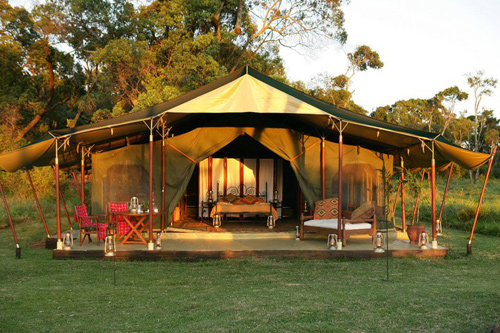 9day/ 8night Accommodation Itinerary - subject to changes based on availability
Night 1 & 2: Nkilenya, Lemek Conservancy
Night 3 & 4: Mara River, Mara North Conservancy
Night 5 & 6: Out Of Africa Camp, Mara Triangle
Night 7 & 8: KO8, Mara North Conservancy
7day/ 6 night Accommodation Itinerary - subject to changes based on availability
Night 1 & 2: Nkilenya, Lemek Conservancy
Night 3 & 4: Mara River, Mara North Conservancy
Night 5 & 6: KO8, Mara North Conservancy
Room Occupancy
Single supplement is not mandatory if you are willing to share.
 Meals
Meals
All meals are included from lunch on Day 1 to breakfast on your last day.
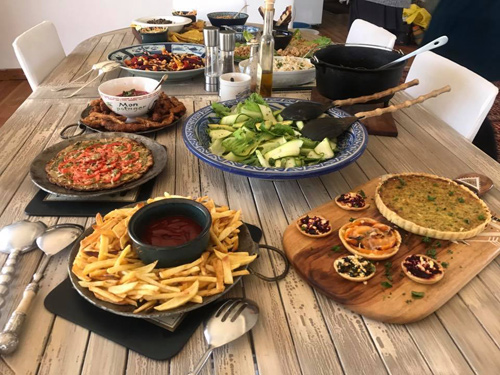
The dining tent is furnished with tables and chairs for elegant meals in camp, which include a variety of fresh fruits, vegetables, meats, fish, and fowl. These meals are prepared over open fires by our camp chefs and served by waiters. All food is locally sourced with 'full-monty' breakfasts, alfresco lunches, and candlelight dinners. Bread is baked daily and ice is made in our safari freezer.
The bush-bar is stocked with imported wines and spirits along with a selection of local beers, sodas, and bottled water.
Dietary Restrictions
We can cater to most dietary restrictions with prior notice.
This trip
includes some wine with dinner
and
can accommodate special dietary requests.
|
Tack:
|
|
English tack - General all purpose English saddles, and French Calvalry saddles. Most horses go in a snaffle bit. Double sided saddle bags are provided.
|
|
Horses:
|
|
Somali-Arab crossbreds & Thoroughbreds.
|
|
Pace:
|
|
Moderate with long trots and canters, 4-8 hrs per day, covering 20-40km
|
Walk |
Trot |
Canter |
|
|
Level:
|
|
(3
to
3
out of 5) Intermediate+
|
|
Age:
|
|
Min
8
|
Max
80
|
|
Weight:
|
|
Max
200 lbs / 90 kg
|
|
Riders:
|
|
Min
4 riders
|
Max
12 riders
(per riding group)
|
Max Capacity
12
|
Riding Level
Participants should be competent and confident at all paces (surprises in the bush cannot be predicted) and have an intermediate level of fitness and riding ability. Riders must have the ability to trot for stretches of 10 minutes at a time and be able to gallop out of trouble.
The guide will assess the capability of each rider and should he feel that any rider is not competent and therefore imposes a risk to themselves or others, he will ask them to continue the safari in a vehicle rather than on horseback.
Pace
We ride between 4 to 8 hours, covering 20 to 50 kilometers per day. Full days of riding when we move camp are alternated with days where we ride out of camp and return for lunch and a siesta in the afternoon.
Horses
Our stable is home to over 25 safari horses – a mixture of Somali-Arab crossbred and thoroughbreds. The majority of these have been bred and raised at home on our wildlife conservancy in central Kenya. Living at close quarters with wild animals, our horses are familiar with being amongst big game, have great endurance and are evenly tempered. Under the professional guidance of our horse master and her team of grooms, each safari horse is carefully schooled, exercised, and loved, for the sole purpose of carrying our guests safely through the African wilderness.
Tack
We ride in the English style using very comfortable French cavalry and English general–purpose saddles. Most horses are tacked in a snaffle bridle and double-sided saddlebags are provided for each member to carry water bottles, cameras, and rain gear.
Safety
A professional riding guide leads every safari. A safety briefing is given at the beginning of the safari with detailed information about how to handle a big game situation.
A small medical kit is carried on horseback and a more comprehensive kit is kept in camps.
The mobile camps, vehicles, and guides have radio communication, mobile phones, or satellite phones in case of an emergency.
Insurance
It is one of our conditions that all guest must have adequate medical and comprehensive travel insurance in case of cancellation, curtailment and other emergencies, should they arise. Insurance details must be provided prior to travel.
Flying Doctor
We provide all our clients with membership to the Flying Doctors Society of Kenya. This service covers emergency medical evacuation to a hospital in Nairobi, at which point your personal medical insurance will take effect.
Weight Limit
Our weight limit is 90 kg (200 lbs). However, we can offer a special program for heavier riders, including shorter rides, game drives, walks and cultural visits.
Staff
Gordie was initiated into the safari world as a youngster. Born in Kenya, he guided his first safari aged 18 and has over 30 years’ experience in the bush. Today, his untamed love of all things wild and his passion and respect for Africa’s people and wildlife, make Gordie a fascinating and inspiring character.
Felicia’s talents encompass all aspects of safari – she’s a brilliant equestrian, an inventive chef, a qualified Bowen therapist and engaging company. She married Gordie in 2014.
Pete has been a professional safari guide for over 45 years. He has dedicated much of his life to conservation and is very proud to have been a founder member of the Masai Mara Conservancy and an honorary warden with the Kenya Wildlife Service.
Pierre is a third generation Kenyan who grew up living under canvas with his father, a well-known conservationist. He feels most at home in the bush. Pierre spends all of his time on safari with guests or friends. His love of the bush is contagious and his knowledge is outstanding.
Non-Riders
Non-riding participants are welcome to join their riding partners. They will spend their days game viewing in a safari vehicle (4x4) or on foot with their own professional safari guide.
Passports
Passport valid for three months from date of entry required by all nationals referred to in the chart with at least one blank page.
Visas
Required by all nationals referred to in the chart above except the following:
(a) all holders of a re-entry pass to Kenya.
(b) 1. Nationals of Cyprus.
Visa Note
(a) All nationals referred to in the chart above may obtain a visa on entry in Kenya. (b) Nationals not referred to in the chart above are advised to contact the embassy to check visa requirements (see Contact Addresses). (c) Multiple-entry visas may only be issued to nationals of the United Kingdom.
Types of Visa and Cost
Single-entry: £35. Multiple-entry: £70. Transit: £15. On arrival: US$50.
Note: If the application is referred to Immigration in Nairobi, an additional £7 will be payable.
Validity
Single-entry: up to three months from date of issue; Multiple-entry: one year from date of issue. Renewals (up to six months) or extensions can be made at Immigration in Nyayo House, Uhuru Highway, Nairobi or at Kisumu and Mombasa. The period of stay in Kenya can be given at the port of entry (maximum three months).
Applications to:
Consulate (or consular section at embassy or high commission); see Contact Addresses.
Working Days Required
Three (applying in person) or one week from date of receipt (postal applications). If the visa has to be referred to Nairobi, it will take up to six weeks or, in some cases, longer.
| Passport Required? |
| British |
Yes |
| Australian |
Yes |
| Canadian |
Yes |
| USA |
Yes |
| Other EU |
Yes |
| Visa Required? |
| British |
Yes |
| Australian |
Yes |
| Canadian |
Yes |
| USA |
Yes |
| Other EU |
Yes |
| Return Ticket Required? |
| British |
Yes |
| Australian |
Yes |
| Canadian |
Yes |
| USA |
Yes |
| Other EU |
Yes |
This information is not being updated on a regular basis. Hidden Trails does not
take any responsibility for the accuracy of the above information. Please, consult
the embassy or consulate for updated info.
|

|
|
|
Masai Mara Ride - Aloe Blossom
Tour Code:
IT-KYRT01
9 days /
8 nights
Dates :
Available all Year
Trip Rating :
Difficulty :

Riding Level Explained | A | Beginner
 | Beginner A rider who has limited experience, is unable to post the trot and does not canter. | | B | Novice
 | Novice A rider who is capable of mounting and dismounting unassisted, capable of
applying basic aids, comfortable and in control at the walk, moderate length posting
trots, and short canters. | | C | Intermediate
 | Intermediate A rider who has a firm seat, is confident and in control at all paces
(including posting trots, two point canters and gallops), but does not ride regularly. |
| D | Strong Intermediate
 | Strong Intermediate An intermediate rider who is currently riding regularly and is comfortable in the saddle for at least 6 hours per day. | | E | Advanced
 | All of the above, plus an independent seat, soft hands, and capable of handlinga spirited horse in open country. |

Lodging:

Introduction
Day to Day Itinerary
Rates | Dates
Accommodation
Tack:
English tack - General all purpose Eng...
Horses:
Somali-Arab crossbreds & Thoroughbreds...
Pace:
Moderate with long trots and canters, ...
Walk,
Trot,
Canter,
Airport:
Jomo Kenyatta International Airport (NBO)
Location on Google Map
Video
Image Gallery
Image Slide Show
Customer Trip Rating
Climate
What To Bring
Download tour PDF
|